MAKERS
Many graduate students and faculty members in History of Art are also artists. This brief photo-essay presents a small number of their recent works.
Casey Carsel
PhD Student
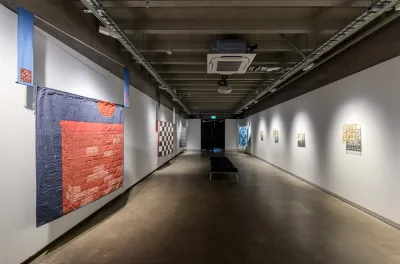
I have been a practicing visual artist for about a decade now. In my latest solo exhibition (which opened the same week as my first week of PhD studies) I expanded upon the symbolist visual language of my textile practice and presented papercut works for the first time.
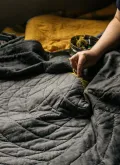
Throughout my visual practice I am particularly invested in Jewish cultural history in diaspora and the ways in which stories travel.
You can see more of my work at coca.org.nz and caseycarsel.com.
Benjamin Jones
Assistant Professor
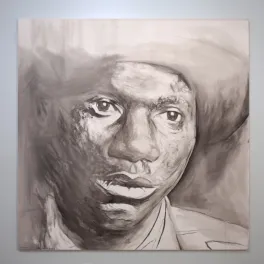
Will Brown, is a 2019 portrait by Benjamin L. Jones that depicts a man who was tortured, mutilated, lynched, burned and then paraded through downtown Omaha, Nebraska a century ago. In this ongoing series, Dr. Jones innovated the use of melanin and skin lightener to paint on cotton canvas, a method he regards as an intervention.
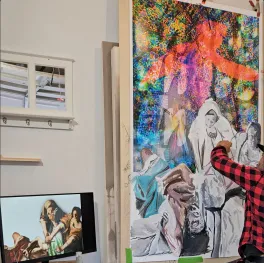
Dr. Jones is currently working to synthesize various modes in his studio practice under the banner of “weaponized incompetence” in relationships, so as to painstakingly face the reality that the screens and apps that are supposed to connect society, instead lure us into alienation–like narcissus into the pool of our demise. For more see: benLjones.com
Bowie Kim
PhD Student
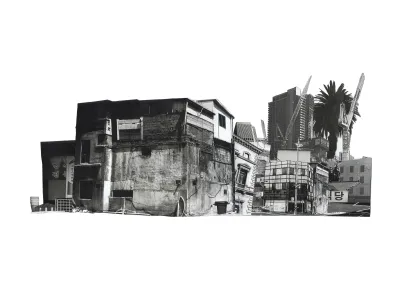
The collage series ‘The things’ (2017) explores the extraction of objects from their original spatiality and temporality. Through the photocollage series, I aimed to show how an artist constructs the context of an artwork by observing and selecting surrounding objects.
Carlos Rivas
Associate Professor
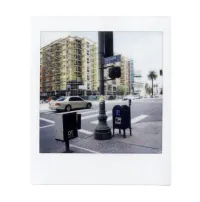
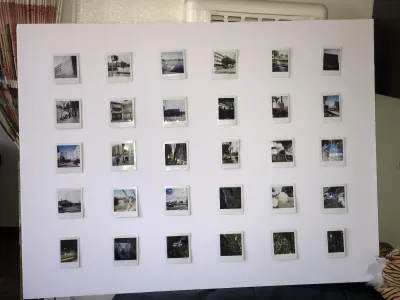
During the latter part of graduate school, I was Carlos Rivas on campus, but Carlos Maravilla in the streets. I first learned about Charles Marville, one of the first prominent photographers in France, in an art history course and his work really spoke to me. He photographed Haussmann’s “renovations" in Paris and his photography gives us a glimpse of what some working-class and medieval neighborhoods looked like before they were bulldozed for new development. As I was living on Mariposa and 7th at the time in L.A., I felt like I was living through something similar.
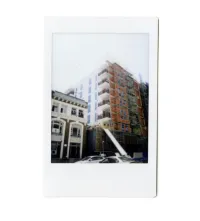
During the Garcetti administration, no matter where you looked, if you were in Central L.A. a building was going down, and a new one going up in its place in every city block without exception. Once-empty parking lots were now dotted with high-rise condos. The city I knew was being destroyed and a new one taking its place. As a lifelong photographer, I had to document it. With analog. Although I dreamed of waltzing through the streets with a large format camera much like Marville himself would have done (part performance, part photography), I opted for the seemingly toy-like “Instax” mini instant film line developed by Fujifilm. Cheaper than large format and it just seemed like a fitting way to capture the ephemeral nature of the transformation itself. I wore a 35mm slide as an earring, and voilà, I was Carlos Maravilla.
Peter Smyth
PhD Student
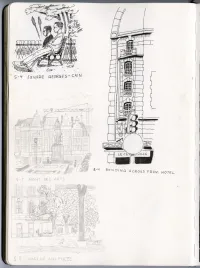
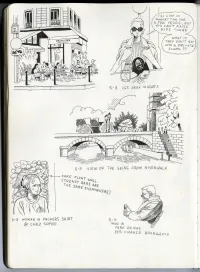
Between visits to museums, Peter enjoys drawing from life in their sketchbook. They made these drawings on a research trip to Paris and Brussels last May.
Emilela Thomas-Adams
PhD Student
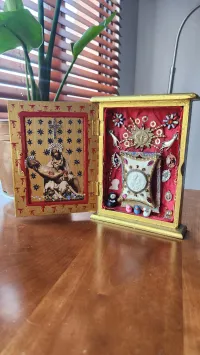
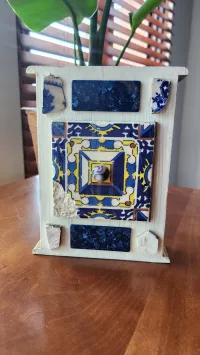
Emilela has been making mixed media works over the past few years, using found objects and collage.