Tell us about your current research. What are the key questions you are exploring in your dissertation?
My dissertation examines works of art from medieval Germany and the Low Countries which were made by, for, and about nuns. I am particularly interested in works of art which represent or interact with enclosure, that is the system of physical and social boundaries meant to separate female religious communities from the outside world. Religious works of art were often used in the convent to promote and enforce enclosure, for example envisioning the convent as a walled garden of Paradise, or picturing saints in contemplative ecstasy as models for nuns to aspire to. It could also include works of art which did not serve a devotional purpose. Nuns in late medieval Nuremberg, for example, portrayed themselves in their manuscript art as paradigmatic workers contributing to the economic and social success of the convent from within.
In my dissertation, I examine how these works of art about convent life are made, and the ways in which the production of artworks can make or break enclosure. In the course of my research, I have learned that works of art which promote convent life also encourage critical examination of its architectural and social boundaries. Passing through the walls of the convent in their making and use, works of art could create links between a variety of communities separated by monastic enclosure. I hope to use works of art to study the larger networks of labor which supported medieval convent life, particularly the creative agency of artistic communities both inside and outside the cloister.
What has it been like living and working in Germany over the past year?
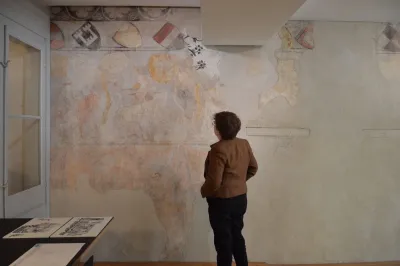
It has been a pleasure to live in Munich this year, where in addition to enjoying Bavarian food and the plentiful public transportation, I have been a fellow-in-residence at the Central Institute for Art History (Zentralinstitut für Kunstgeschichte) where I have been working on my dissertation. The Institute building was used in the aftermath of World War II as the Allied central collecting point for the repatriation of Nazi-looted artworks. From this massive collection, research, and repatriation effort emerged the Zentralinstitut, which today is the most important art historical research institute and library in Germany. As one of a global cohort of fellows and scholars, I both use the library and participate in a regular program of lectures and discussions which encourage interdisciplinary dialogue. I have met many wonderful colleagues who have expanded my thinking and my travel itinerary in Germany. Recently I visited Zurich with a fellow medievalist and we were able to view a rare set of murals preserved in a Jewish home which portrayed courtly hunting scenes. I might not have known to visit this amazing site if not for the colleagues I have met at the Zentralinstitut.
Tell us about a research site you visited recently and what you found there.
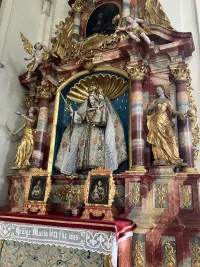
This summer I was able to visit one of the main convents in my dissertation: St. Katharinenthal Convent in Diessenhofen, Switzerland. In the modern day, Katharinenthal is a long-term hospital and care home, but many of its medieval artworks and baroque architecture are preserved in situ. I visited Katharinenthal in order to view two thirteenth-century works of art produced by the workshop of Heinrich of Konstanz, an artist whose critical biography is an important component of my third dissertation chapter. I was able to view both works still on display in the preserved church, a life-size sculpture of the Virgin and Child (pictured here decked out in clothing and wigs made for them during the Baroque period) and a large crucifix which because of the specific humidity conditions cannot be moved or exhibited outside Katharinenthal. Seeing these two works was only the beginning of my visit to Katharinenthal. My guide from the Thurgau Monument Preservation Office was able to show me all the medieval remnants of the convent, not only artworks but decorated furniture and remnants of the thirteenth century stone architecture.
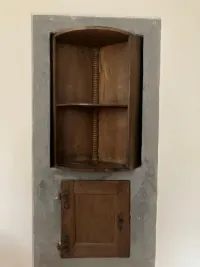
A highlight of the trip was Katharinenthal’s intact rad, or turn, which was used by the nuns in the eighteenth century to pass objects from the church (which was public) into the nun’s choir (which was private). Turns such as the one at Katharinenthal were a standard feature of convent walls in the late Middle Ages, when nuns practiced the strictest enclosure. These rotating cabinets were installed near the Sprachfenster, or speaking windows, and outsiders would be able to pass letters, small works of art, or other packages into the convent without the nuns seeing out or visitors seeing in. According to some convent records, there were even instances when visiting family members would place a swaddled baby in the turn and rotate it so that the nun inside would be able to see their new relative. The turn was constantly monitored, and being “turnkeeper” was a duty held only by the most senior and trusted nuns. While several diagrams and descriptions of the wheels used in convents exist, there are very few which remain intact. It is a crucial piece of technology which created an opening—however controlled—in the boundary of enclosure and likely played a key role in the movement of artworks into and out of the convent.